Pearson Edexcel · A-Level · Economics B
Course version: 9EB0 · Version from Sept 2015
Business regulation: c) Protecting consumers
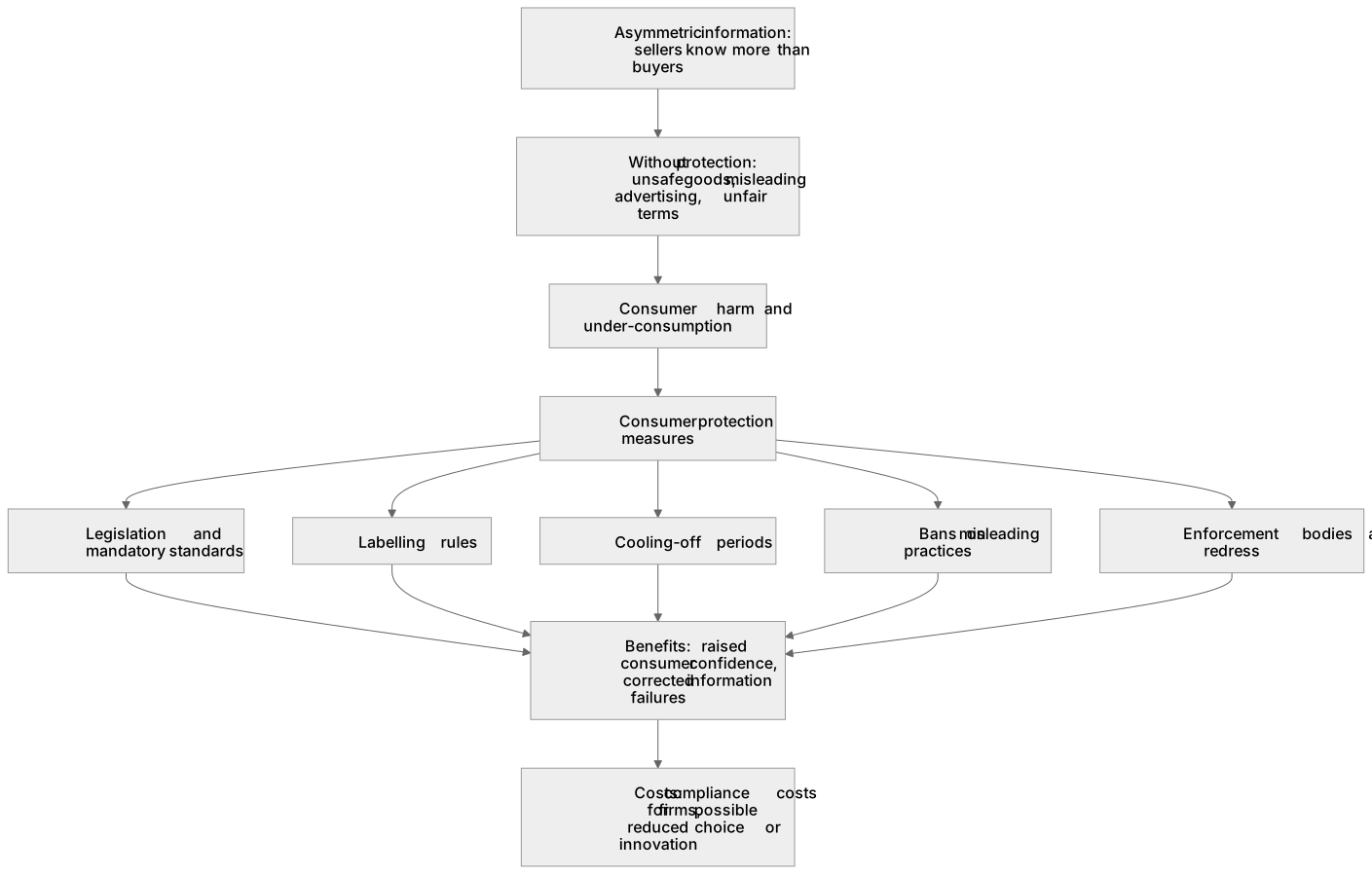
Consumer protection addresses market failures such as asymmetric information, where sellers know more about product quality, safety or contract terms than buyers.
Checked against the Pearson Edexcel 9EB0 specification (opens in a new tab) on .
- Point 3 of 5
- 4 key terms
Study notes
From the checked teaching notes for this specification point.
The idea
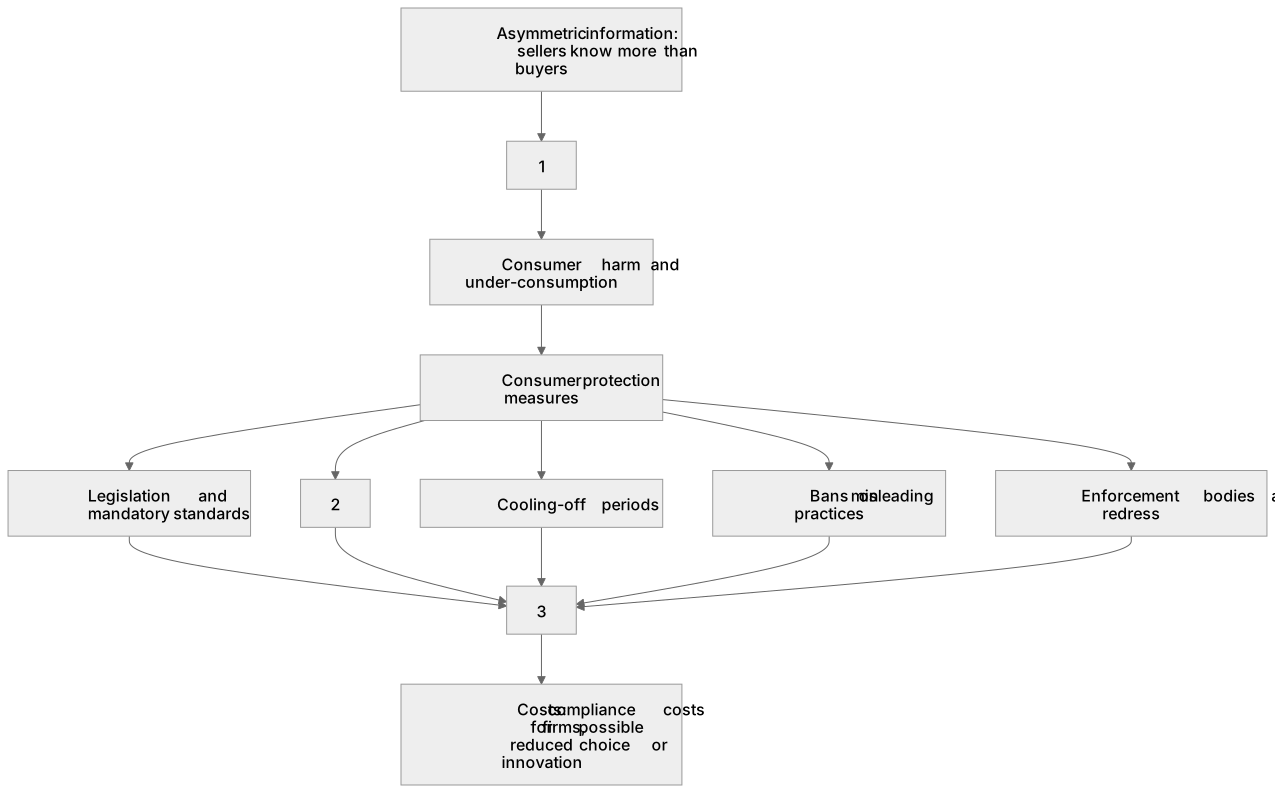
Consumer protection addresses market failures such as asymmetric information, where sellers know more about product quality, safety or contract terms than buyers. Without intervention, firms may supply unsafe goods, use misleading advertising or impose unfair terms, and consumers may under-consumption or suffer harm. Governments and regulators use legislation, mandatory standards, labelling rules, cooling-off periods, bans on misleading practices and bodies that enforce compensation or redress. Effective protection can raise consumer confidence and correct information failures, but it imposes compliance costs on firms and may reduce choice or innovation if rules are excessive.
What earns the marks
- Defines asymmetric information as a situation where one party, usually the seller, has more or better information than the buyer.
- Explains that without consumer protection, asymmetric information can lead to unsafe products, misleading claims and unfair contract terms.
- Identifies legislation and mandatory standards as tools that set minimum safety, quality or labelling requirements.
- Identifies enforcement bodies and redress mechanisms as ways to compensate consumers and deter poor firm behaviour.
- Evaluates that consumer protection can increase confidence and correct market failure but may raise firms' compliance costs and reduce consumer choice.
- Applies the analysis to a specific market, such as energy, telecoms or financial services, to show how protection operates in practice.
Common mistakes and how to put them right
Misunderstanding: consumer protection is only about price.
Put it right: It also covers safety, quality, information, contract terms and redress, not just the price paid.
Misunderstanding: all regulation benefits consumers with no cost.
Put it right: Regulation can raise firms' costs, which may be passed on to consumers, and excessive rules can reduce choice or innovation.
Misunderstanding: asymmetric information means consumers know more than firms.
Put it right: Asymmetric information usually means the seller knows more about the product than the buyer, which is why protection is needed.
Misunderstanding: consumer protection laws are always fully effective.
Put it right: Enforcement matters, and weak enforcement or low consumer awareness can limit the impact of legislation.
Exam tips
- Identify the specific market failure in the question, such as asymmetric information or externalities, before selecting an answer.
- Distinguish between laws that set standards and bodies that enforce them, as questions may test either role.
- Eliminate options that claim regulation has only benefits or only costs, because consumer protection involves trade-offs.
- Use real examples from regulated markets such as energy or financial services to check whether an option is plausible.
Try the lesson
The start of the Business regulation: c) Protecting consumers lesson, made from checked teaching notes for this specification point.
Have a go first
Which of the following is a primary objective of consumer protection legislation in the UK?
Listen
Consumer protection addresses market failures such as asymmetric information, where sellers know more about product quality, safety or contract terms than buyers. Without intervention, firms may supply unsafe goods, use misleading advertising or impose unfair terms, and consumers may under-consumption or suffer harm. Governments and regulators use legislation, mandatory standards, labelling rules, cooling-off periods, bans on misleading practices and bodies that enforce compensation or redress. Effective protection can raise consumer confidence and correct information failures, but it imposes compliance costs on firms and may reduce choice or innovation if rules are excessive. A strong answer earns marks for these points. Defines asymmetric information as a situation where one party, usually the seller, has more or better information than the buyer. Explains that without consumer protection, asymmetric information can lead to unsafe products, misleading claims and unfair contract terms. Identifies legislation and mandatory standards as tools that set minimum safety, quality or labelling requirements. Identifies enforcement bodies and redress mechanisms as ways to compensate consumers and deter poor firm behaviour. A common slip: Misunderstanding: consumer protection is only about price. Instead, it also covers safety, quality, information, contract terms and redress, not just the price paid. Exam tip: Identify the specific market failure in the question, such as asymmetric information or externalities, before selecting an answer.
See it
Key words
Say what each word means before you turn the card.
Asymmetric information and market failure
Try answering aloud or in your head before turning the card.
Consumer protection legislation and standards
Try answering aloud or in your head before turning the card.
Enforcement, redress and compensation
Try answering aloud or in your head before turning the card.
Compliance costs and regulatory burden
Try answering aloud or in your head before turning the card.
See every definition
- Asymmetric information and market failure
- A situation where one party, usually the seller, has more or better information than the buyer, which can lead to unsafe products, misleading claims and unfair contract terms.
- Consumer protection legislation and standards
- Legislation and mandatory standards set minimum safety, quality or labelling requirements, and include rules such as cooling-off periods and bans on misleading practices.
- Enforcement, redress and compensation
- Bodies that enforce protection and mechanisms for redress compensate consumers and deter poor firm behaviour.
- Compliance costs and regulatory burden
- Protection imposes costs on firms, and excessive rules may reduce choice or innovation.
Label the diagram
Some boxes have lost their names. Pick the right name for each number.
1Box 1
2Box 2
3Box 3
There is more to this lesson
The full lesson goes on to check your understanding and help you earn the marks. Create a free account to carry on, with your progress saved.
A week of Premium from your first lesson · Then the free plan continues · No card, no charge
Test your understanding of Business regulation: c) Protecting consumers
Active recall beats re-reading. Take an instant quiz now to test what you’ve learned and lock it into long-term memory.
A week of Premium from your first lesson · Then the free plan continues · No card, no charge